By Nina Ying Sun
ASSISTANT MANAGING EDITOR
Published: July 15, 2014 3:03 pm ET
Updated: July 15, 2014 3:10 pm ET
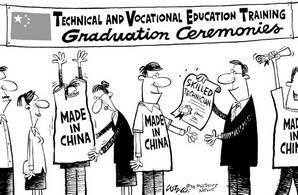
Image By: Rich Williams
My father didn’t get to go to college after high school, thanks to the Cultural Revolution that left China’s educational system in disarray.
Instead, he started working as a clerk for a government agency.
After the Cultural Revolution, part-time college programs became available. He took up the opportunity and studied in the evenings and on the weekends.
When I was a baby, he used to take me with him to classes, since my mother had to work overtime. I was quiet but curious, so I’ve been told.
He received a bachelor’s degree well into his 30s. But he never stopped studying. He obtained multiple professional certifications in his field. Then, he earned a master’s degree in his 40s. And he finished his second bachelor’s degree in his 50s. Now, in his 60s, he is studying English, because he was taught Russian in school during that special era in China.
Because my father was deprived of education early on in his life, he has a powerful passion and drive for gaining knowledge. He appreciates the opportunity to study in a way that I and my generation (born in the 1980s) can never truly understand.
My father and his generation went through a lot. They put so much hope on their next generation’s education as if it could make up for what they missed.
As a result, my generation embraced a huge wave of expansion of the education systems at all levels. Constant construction on campus and ever-growing class sizes are imprinted in my school memories, from kindergarten through college.
By the midpoint of the first decade of the 2000s, China started sending millions of college graduate into the job market each year.
The market value of a college degree dropped, in sync with the surplus. In the meantime, the expansion of college enrollment wasn’t always supported with sufficient infrastructure and teaching resources.
While the economic boom created a great need for talent with immediately applicable knowledge and skills, universities oftentimes fell short on equipping the students with the right skills and capabilities.
Last year, only 72 percent of college graduates had jobs lined up by the time they graduated, a new record-low in history. The average starting salary for college grads was a mere 3,378 yuan ($542) per month, lower than many plastics factory jobs.
That’s exactly why apprentice programs, like the one Engel Machinery launched in Shanghai, have been quickly gaining traction in China.
Some education experts call 2014 the year of TVET (Technical and Vocational Education Training) in China, as major reforms are unfolding.
This week, the State Council issued a paper announcing the goal to build a “world-class” modern vocational education system by the end of this decade. That’s only fitting for the world’s manufacturing powerhouse.
The number of skilled workers is expected to double during this time period, despite an aging population, addressing China’s current work force issues: a scarcity of labor and a surplus of college grads.
The government, in the announcement, encouraged industries and enterprises to participate in, cooperate with, and/or organize various forms of training. Modern apprenticeship is certainly a key part of it, helping students hone solid technical skills and absorb real business knowledge.
In Engel’s case, its Shanghai-Austria dual apprentice program for computer-controlled machinery operators is a successful project that involves cooperation with a local partner, the Shanghai Information Technology College.
There’s a lot China can learn from Europe’s rich tradition of manufacturing training that has grown apprentices into world-renowned masters. And the Chinese are fully recognizing it. On social media, young people are circulating articles about German apprentice programs and their roles in creating some of the most legendary brands and businesses in the world.
If the education reform carries out as planned, it will upgrade China’s new generation of manufacturing workers and the products they make. Maybe, one day, “made in China” will become a preferred product label, rather than frowned upon, in the global market. |